The same slip, repeated
You make the identical error again and again - and no one has explained the root cause.
A structured, side-by-side reference system built for one purpose: helping you remember why two near-identical āyāt differ - not just find them. Every pair mapped, annotated and organised for real revision.
616 pairs and families · all 30 Juz · 1,358 cards
Instant access by email. Phone, tablet or computer.
On the waitlist? Your 30% code is in your email, until Wednesday 4 November.
or download the free Revision Blueprint → See inside the guideNot sure this guide is for you yet?
Take the free 2-minute assessmentNot because you are a weak Hāfidh - but because near-identical wording has never been mapped in a way built for memory. These are the moments this guide is made for.
You make the identical error again and again - and no one has explained the root cause.
Your mind goes blank, the congregation waits, and the moment stays with you afterwards.
You know the āyah - but you keep confusing it with a near-identical one in another Surah.
Passages you secured years ago are blurring at the edges, and you can't pinpoint where.
There are sections you skirt around, because you already know exactly where you might trip.
Mutashābihāt have always been the weak point - and repetition alone has never solved it.
Huffādh who recite publicly and can't afford a mid-prayer blank.
Anyone who repeatedly confuses two near-identical āyāt.
Those tired of "just revise more" and ready for a system.
Anyone who wants to revise without that quiet fear of slipping.
It's for the Juz you already know, whether you finished years ago or you're in your final years of Hifdh.
Every card comes in 3 Arabic fonts: Indo-Pak, Amiri and Scheherazade.
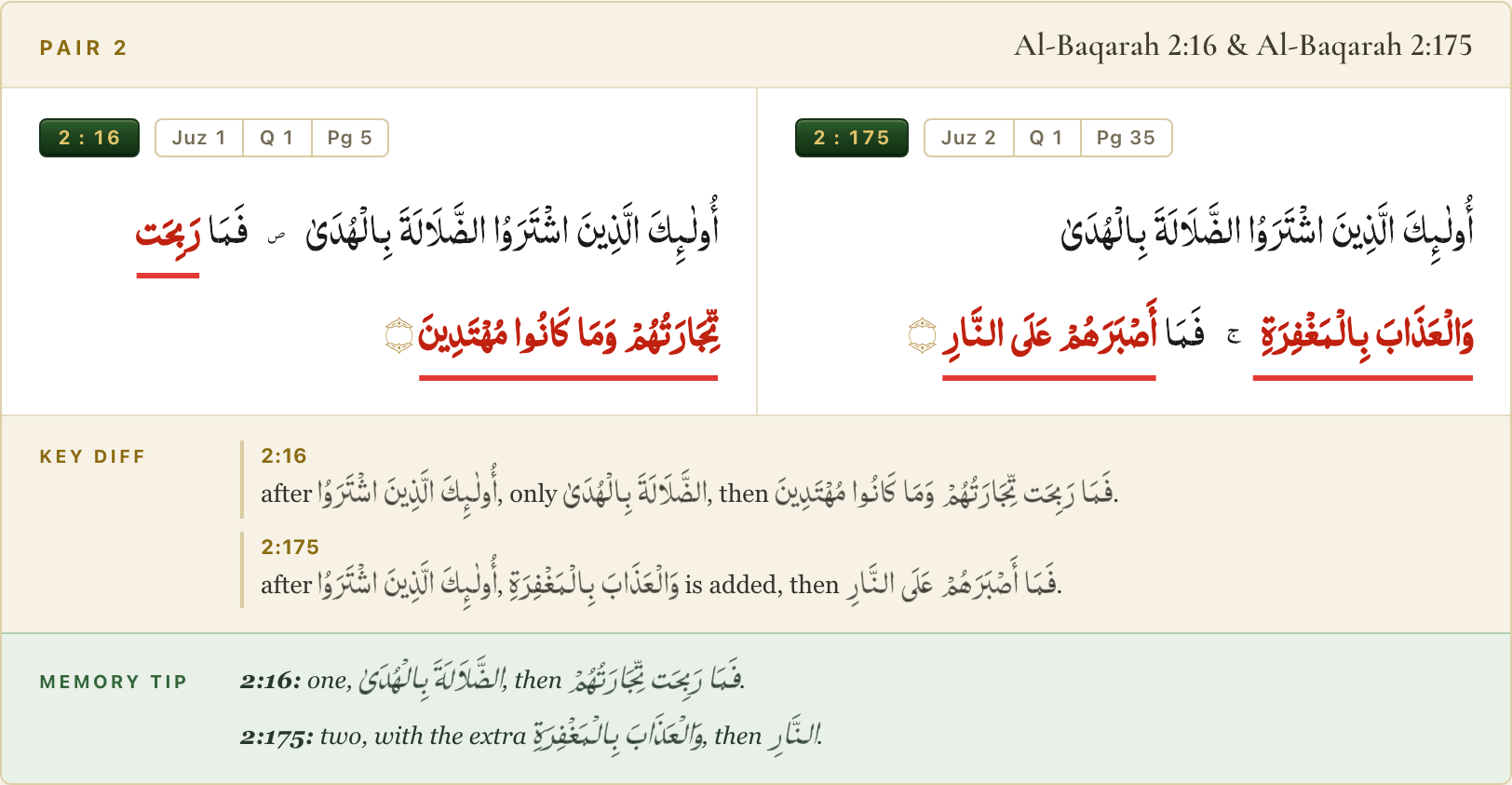
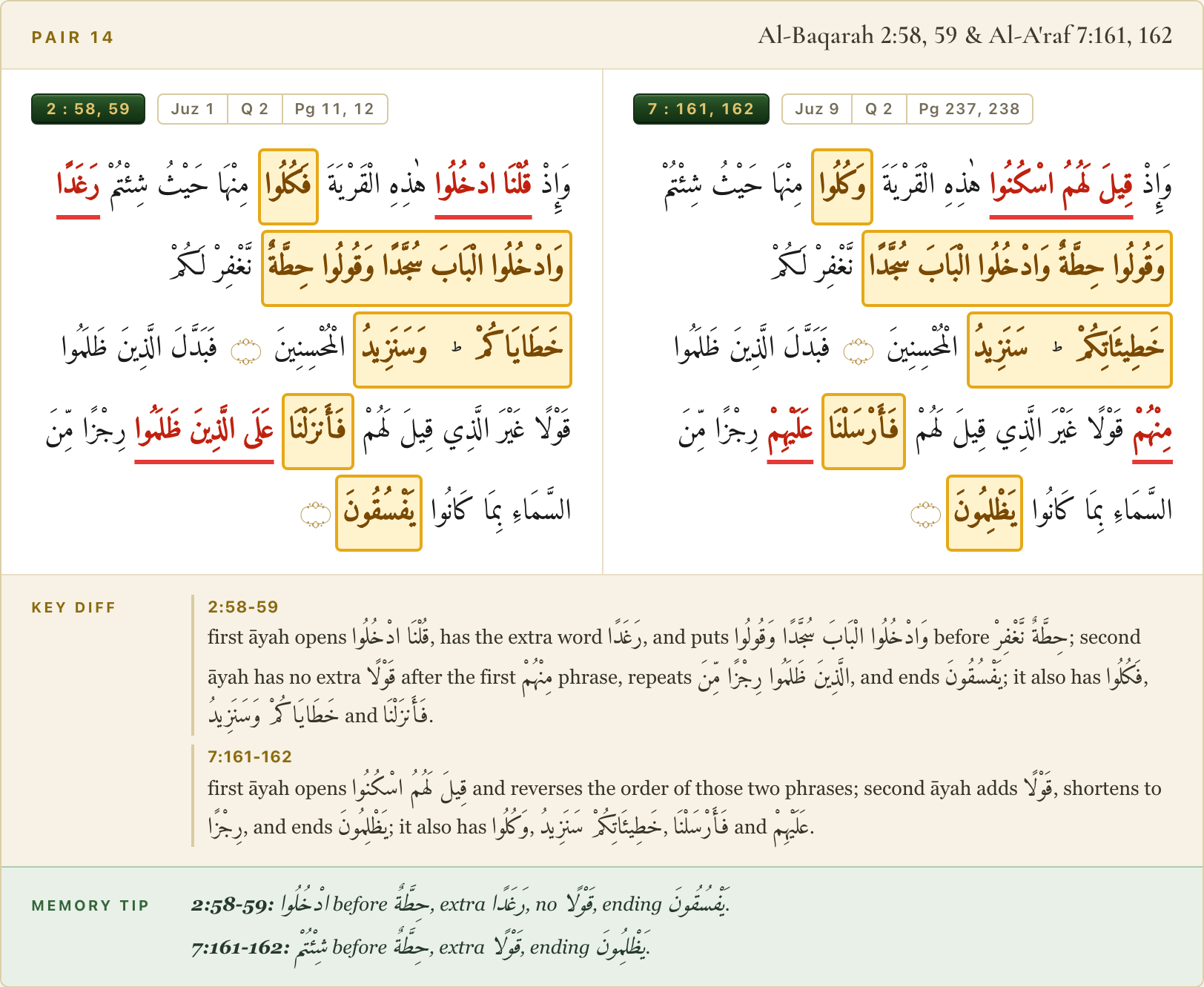
Commonly confused āyāt are placed directly beside each other, with the differing words highlighted - so the precise point of confusion is visible at a glance, not buried in a list.
Each pair carries a plain-language explanation of the exact wording change, followed by a practical memory tip designed to hold the difference in place through everyday revision.
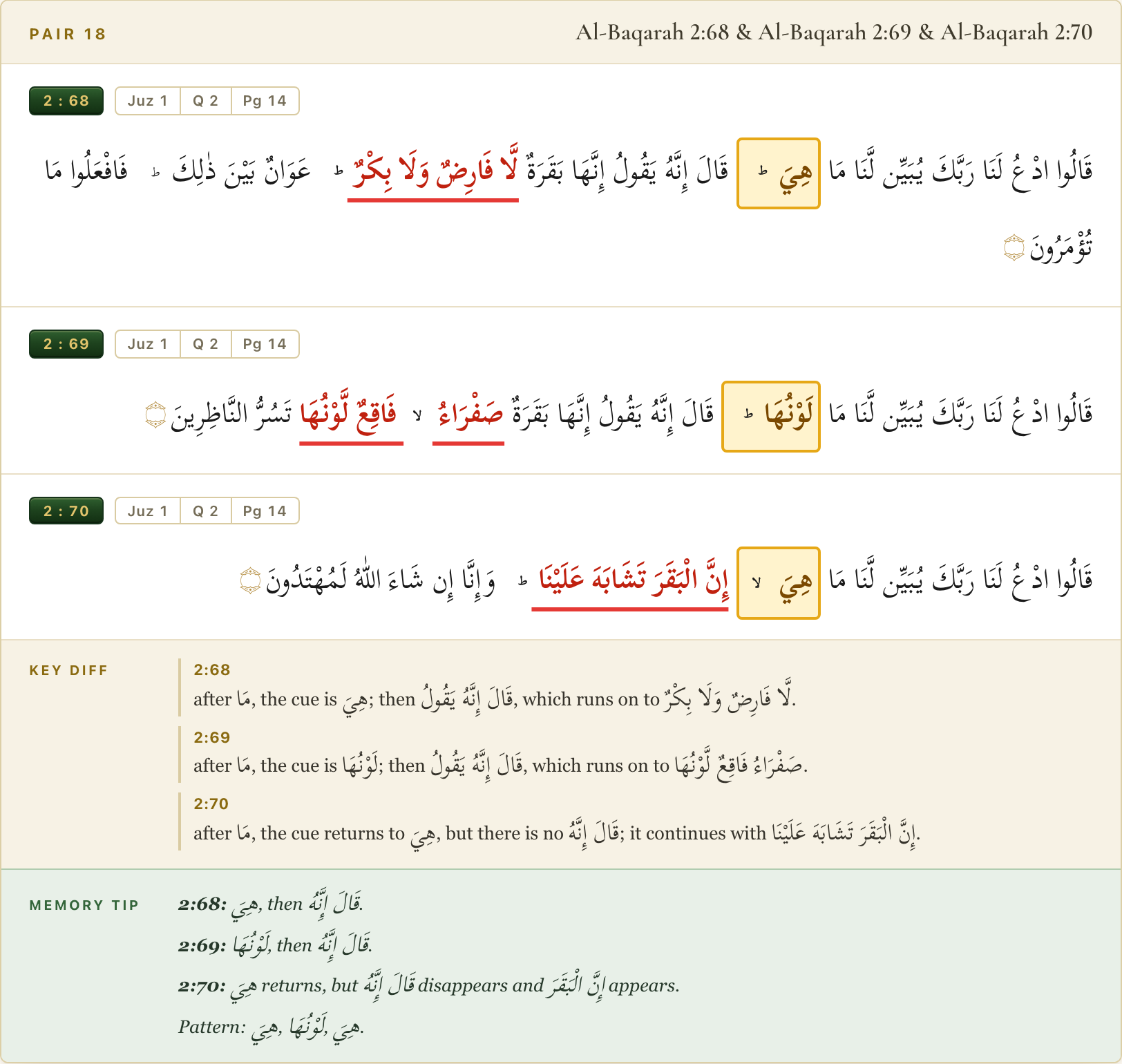
Recurring structures across similar passages are surfaced deliberately, so you build recall through recognisable patterns rather than isolated memorisation.
Search by pair number, āyah, surah name, or a word in Arabic - with or without vowel signs - or type it the way it sounds in English.
Every card has Save, Note, and Solid / Shaky, so you can see what is secure and what still needs work. Revise a Juz is there for your next revision session.
Choose from 3 Arabic fonts, including an Indo-Pak style, set the text size you are comfortable with, and switch to night mode when you revise after dark.
Where an āyah has more than one look-alike, up to 7 similar āyāt sit together on a single card, so you see the whole family at once.
Where two āyāt end the same way, the next āyah is shown too - so you know what comes after each ending.
Indo-Pak waqf (pause) signs are shown at their exact place in the āyah, so you can see where to pause.
A fair question - and there are genuinely excellent free resources out there.
Most free resources help you find which āyāt are similar - and many do it well. If you simply need to locate pairs, they are a real gift, and this guide is not here to replace them.
This guide is built to help you remember them. The value isn't collecting information - it's organising, comparing, annotating and presenting each pair so long-term revision becomes genuinely easier. It complements what already exists.
One example: most resources give only a surah and āyah number, leaving you to hunt for the page. This guide gives the exact page number in the 13-line Mushaf - and the Juz and quarter it sits in - so you turn straight to the pair in your own copy, instantly, without searching.
Other resources tell you which āyāt are similar. This one shows you why they differ - so you're far less likely to mix them again.

Almost every existing resource answers the same question: which āyāt are similar?
That is useful - but it is not the hard part. Knowing two āyāt resemble each other doesn't stop you mixing them up at Fajr or mid-Taraweeh. What changes revision is understanding the exact wording that diverges, and having a way to make that difference stick.
So this guide was built around memory itself. Each pair is placed side by side, the precise difference highlighted, and a practical memory tip attached - turning a moment of confusion into something you can actually hold onto.
£29.99
One payment. No subscription.
Instant access by email. Personal licence for 2 of your own devices.
Terms of sale | Refund Policy | Privacy Policy
Your 30% code is in your email: £20.99 until 23:59 UK, Wednesday 4 November. Use the email you joined with.
Your waitlist code is saved. It is taken off at checkout when you use the email you joined with.
From teachers and Huffādh who have used the guide.
"Similar Ayaat is a unique piece of work, put together with great time and dedication. It's a valuable resource for Hifz revision and developing a deeper knowledge of similar verses in the Qur'an. May Allah place barakah in this work and reward everyone involved."
Difficult pairs, finally easy to retain
"It breaks down commonly confused āyāt side by side with pinpoint accuracy. The Key Diff and Memory Tips make difficult pairs easy to retain. A game-changer for hifz revision."
A much-needed tool for the community
"A genuinely valuable and much-needed tool. It helps students, teachers and memorisers recite with greater confidence and accuracy. May Allah place barakah in this effort."